By Daniel Reitberg
For years, the promise of household robots lived somewhere between science fiction and flashy technology demonstrations. We watched machines dance, backflip, and fold towels in carefully controlled environments, but very few people actually had robots helping them around the house.
That changed in 2026.
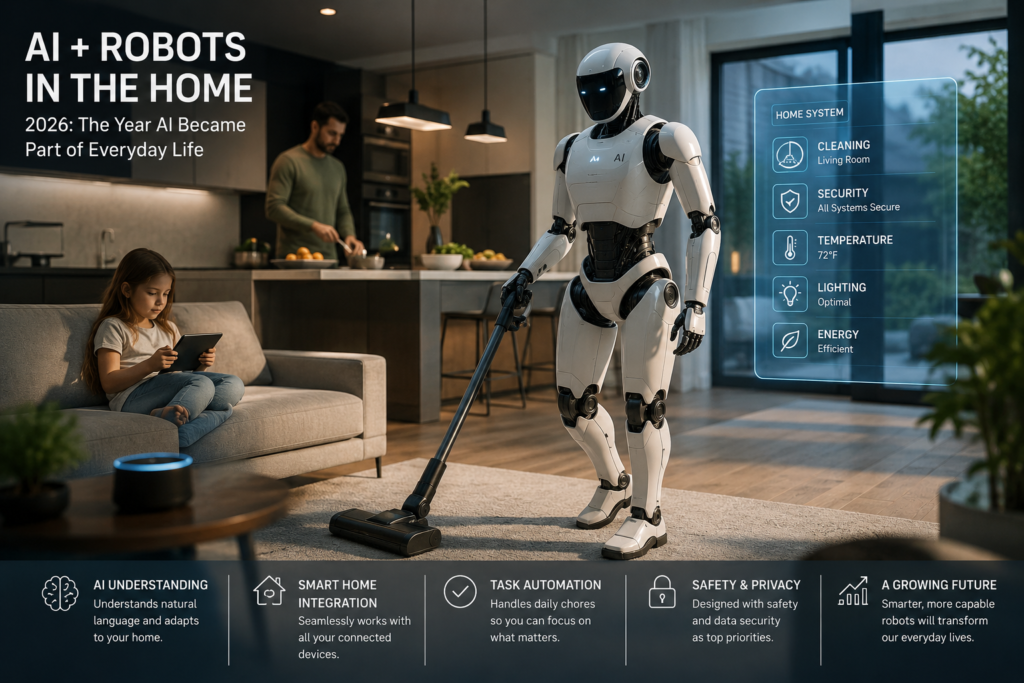
This isn’t the year that every family suddenly owns a humanoid robot. Instead, it’s the year that artificial intelligence became capable enough to move robotics from novelty into practical usefulness. The combination of large language models, computer vision, and increasingly capable hardware has transformed robots from machines that follow rigid instructions into assistants that can understand context, adapt to changing environments, and interact more naturally with people.
AI Is the Missing Piece
Robots have existed for decades. Robotic vacuum cleaners, automated lawn mowers, and warehouse robots are nothing new.
What has changed is intelligence, and this is something that the Author, Daniel Reitberg, has been touting at conferences and speaking engagements.
Modern AI systems can recognize objects, understand spoken language, interpret human intentions, and make decisions in real time. Instead of programming every movement, developers can now teach robots broader concepts and allow them to reason through unfamiliar situations.
Imagine saying:
“Please clean the kitchen after dinner.”
A traditional robot would need hundreds of predefined rules.
An AI-powered robot can identify dirty dishes, recognize countertops that need wiping, understand which objects belong in the dishwasher, and adapt if something has been moved.
That flexibility represents one of the biggest breakthroughs in consumer robotics.
Beyond the Robot Vacuum
Most households already have robots — they just don’t think of them that way.
Robot vacuums, pool cleaners, lawn mowers, and automated security systems have quietly become mainstream.
The next generation expands well beyond these single-purpose machines.
Several companies are now demonstrating robots designed to:
- Fold laundry
- Load and unload dishwashers
- Carry groceries
- Prepare simple meals
- Monitor home security
- Assist elderly family members
- Integrate with smart home ecosystems
Many of these products remain in early deployment or limited release, but the direction of travel is becoming much clearer.
AI Makes Robots Personal
Perhaps the most interesting development isn’t mechanical — it’s conversational.
Because robots can now leverage advanced AI models, they become personalized assistants rather than simple appliances.
Imagine a robot that knows:
- where you normally leave your keys,
- when your children arrive home from school,
- which groceries are running low,
- when your elderly parent usually takes medication,
- and how you prefer your morning routine.
The robot isn’t just completing tasks — it begins understanding your household’s habits.
That’s a fundamentally different category of technology.
The Smart Home Is Becoming an Intelligent Home
For years, smart homes were collections of disconnected devices.
A thermostat.
A smart speaker.
Connected lights.
Security cameras.
Today, AI is acting as the operating system that ties them together.
Instead of controlling devices individually, homeowners are beginning to describe outcomes.
“Get the house ready for guests.”
“Prepare the kitchen for dinner.”
“Check whether every door is locked.”
Robots become physical extensions of that intelligent home, capable of interacting with the real world rather than simply turning devices on and off.
Challenges Still Remain
The technology is advancing quickly, but several challenges remain before humanoid robots become commonplace.
Safety is paramount. Robots operating around children, pets, and elderly family members must behave predictably in constantly changing environments. Companies are investing heavily in software and safety systems to reduce these risks.
Privacy is another major concern. Household robots rely on cameras, microphones, and sensors to understand their surroundings, raising important questions about data collection, storage, and transparency. Researchers continue to examine how these systems can respect privacy while remaining useful.
Finally, cost remains a barrier. General-purpose home robots are still expensive, placing them beyond the reach of many consumers.
Looking Ahead
The robotics industry today feels remarkably similar to where smartphones stood before they became ubiquitous.
The hardware is improving.
The software is improving even faster.
Artificial intelligence is accelerating both.
Industry analysts expect the household robotics market to grow substantially over the coming decade as capabilities improve and prices gradually decline.
The question is no longer if AI-powered robots will enter our homes.
The real question is which tasks we’ll gladly hand over first.
If 2026 is remembered for anything, it may be as the year artificial intelligence stopped living exclusively inside our phones and computers — and began taking its first real steps across the living room floor.