By Daniel Reitberg
For decades, space missions were built around one basic assumption: the smartest decisions would be made on Earth.
A satellite would collect data, send it back to a ground station, and wait for instructions. A spacecraft would follow carefully pre-programmed commands. A rover on Mars would pause while human teams studied images, planned a route, and uploaded the next set of movements. Rocket launches, meanwhile, relied on enormous teams of engineers interpreting streams of telemetry, weather, propulsion data, and safety checks before giving the final “go.”
That model is changing.
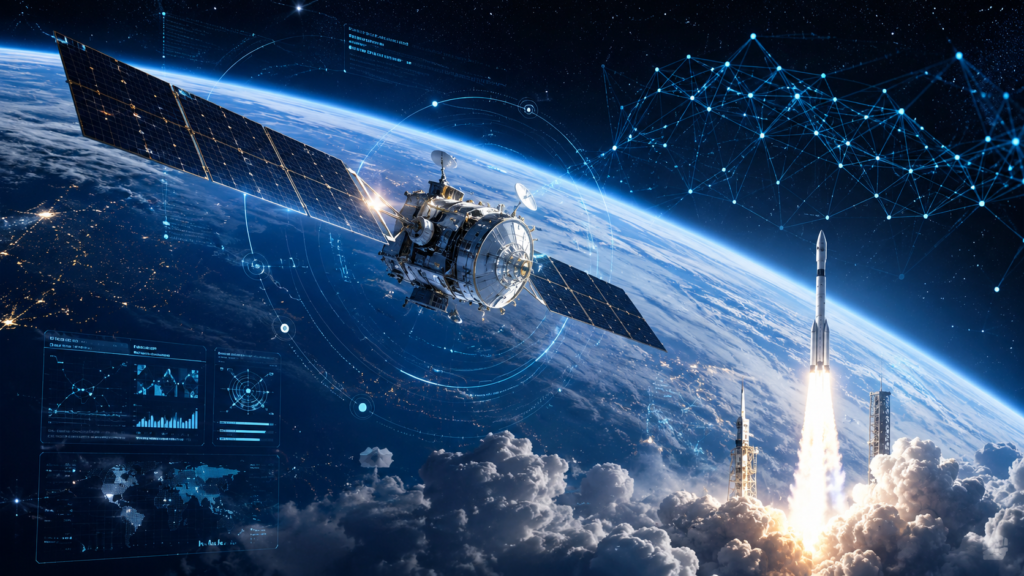
In 2026, artificial intelligence is no longer just a futuristic concept attached to space exploration. It is becoming part of the operating system of modern space missions. AI is being used to help satellites make decisions in orbit, detect problems before they become mission-ending failures, process Earth observation data without waiting for ground stations, assist launch operations, support autonomous navigation, and prepare spacecraft for a future where humans may not always be close enough to take control in real time.
This does not mean rockets are launching themselves with no human oversight. It does not mean satellites are suddenly becoming science-fiction machines. What it does mean is more practical, and in many ways more important: space systems are becoming faster, more autonomous, and more intelligent because they have to be.
There are now thousands of active satellites in orbit. Launch cadence is increasing. Earth observation satellites are producing massive volumes of data. Lunar and Mars missions face communication delays that make real-time human control impossible. Military and commercial operators are demanding faster response times. And companies are exploring entirely new orbital business models, from satellite servicing to space manufacturing to orbital data centers.
AI is becoming the tool that helps make all of that manageable.
Satellites Are Becoming Smarter in Orbit
One of the biggest changes happening in 2026 is the shift from passive satellites to active, decision-making satellites.
Traditional satellites often operate like cameras on a schedule. They pass over a region, collect data, and transmit that data back to Earth. Analysts or automated ground systems then process the information. That approach works, but it has limits. If a wildfire begins, a volcano erupts, or a storm rapidly intensifies, waiting for the next scheduled observation or the next ground command can cost valuable time.
AI changes that equation.
With onboard intelligence, satellites can analyze what they are seeing while still in orbit. Instead of sending every image back to Earth, a satellite can identify clouds, detect changes, flag unusual activity, compress the most important information, or decide which target deserves another look. This is especially important for Earth observation, where satellites may collect far more data than can be efficiently downloaded.
NASA has been testing technologies such as dynamic targeting, which could allow Earth-observing spacecraft to autonomously decide where to make science observations within seconds. That matters because the Earth is not static. A satellite may pass over a developing storm, a flood zone, a ship, a wildfire, or an unexpected atmospheric event. AI allows the satellite to react while the opportunity is still there.
This is the beginning of a major shift: satellites are no longer just collecting information. They are beginning to interpret it.
The Rise of Satellite Swarms
The next step is not just smarter individual satellites, but smarter networks of satellites.
A single satellite with AI is useful. A constellation of satellites that can coordinate with each other is much more powerful.
NASA’s work on distributed spacecraft autonomy points toward this future. The idea is that multiple spacecraft can communicate, divide tasks, adapt to changing mission conditions, and operate more like a coordinated team than a collection of isolated machines. In practical terms, that could mean one satellite detects something important, alerts nearby satellites, and the rest of the network adjusts its observations automatically.
This is especially important for large satellite constellations. As more spacecraft operate in low Earth orbit, the challenge is not only collecting data but managing traffic, communications, observation priorities, power, pointing, and orbital safety. Human teams cannot manually micromanage every satellite in a large constellation at all times. AI can help allocate tasks, prioritize urgent data, and reduce the burden on ground control.
In 2026, companies are also moving toward autonomous satellite network demonstrations. Ubotica and Open Cosmos, working with NASA’s Jet Propulsion Laboratory, announced plans for a multiyear flight demonstration of an autonomous intelligent satellite network called FAME, expected to begin with an initial set of spacecraft in summer 2026. The goal is to move beyond passive data collection and toward federated satellite intelligence, where one spacecraft can trigger follow-on observations from others within minutes.
That kind of capability could be extremely valuable for climate monitoring, disaster response, defense, agriculture, shipping, border security, insurance, and scientific research. Imagine a satellite detecting the early thermal signature of a wildfire and automatically cueing other satellites to gather higher-resolution imagery, track wind-driven spread, and send alerts before the event becomes catastrophic.
That is where space-based AI becomes more than a technical upgrade. It becomes a real-time decision layer above the planet.
AI Is Moving Data Processing Into Space
One of the biggest bottlenecks in modern space operations is data.
Earth observation satellites, radar satellites, communications satellites, and scientific spacecraft generate enormous amounts of information. Traditionally, much of that information has to be transmitted to Earth before it can be processed. But downlink bandwidth is limited. Ground stations are not always in view. Large constellations can create congestion. And for time-sensitive missions, delays reduce the value of the data.
This is why edge computing in space is becoming so important.
AI allows satellites to process information onboard. Instead of transmitting raw data, a satellite can send only the most relevant insights. For example, rather than downlinking thousands of images of the ocean, an AI-enabled satellite might send alerts about illegal fishing activity, ship movements, oil spills, or unusual weather patterns. Instead of transmitting entire wildfire image sets, it could identify fire boundaries and send a compressed, actionable update.
This approach saves bandwidth, reduces latency, and makes satellites more useful in real time.
The concept is also tied to the emerging idea of orbital data centers. In recent research, space data centers are described as satellite-based computing platforms that could process information in orbit and serve other satellites or users on Earth. This is still an early-stage concept, but the logic is clear: as space-generated data grows, not everything can or should be processed on the ground.
In the long term, space may not just be a place where data is collected. It may become a place where data is processed, analyzed, and turned into intelligence before it ever reaches Earth.
Rocket Launches Are Also Becoming More Intelligent
AI is not only changing what happens after spacecraft reach orbit. It is also beginning to influence how rockets are designed, tested, launched, and monitored.
Rocket launches are among the most complex operations humans perform. A launch vehicle has thousands of components, massive fuel loads, extreme temperatures, high vibrations, changing weather conditions, and a narrow window for safe flight. During countdown and ascent, engineers monitor enormous streams of telemetry in real time.
AI can help by detecting patterns that may be too subtle or too fast for human teams to catch immediately.
In launch operations, AI and machine learning can support anomaly detection, propulsion system monitoring, trajectory optimization, weather evaluation, and digital twin simulations. A digital twin is a virtual model of a rocket or engine system that can be tested and compared against real telemetry. If live data begins to diverge from expected behavior, AI systems can help flag the issue faster.
This does not replace launch directors or flight safety teams. It gives them better tools.
For example, machine learning models can be trained on engine test data, previous flights, simulations, and known failure modes. During a launch countdown, those models can help identify whether a pressure reading, temperature change, vibration signature, or fuel flow pattern looks normal or concerning. During ascent, AI-assisted monitoring can help classify anomalies and support faster decision-making.
This matters even more as launch cadence increases. Companies like SpaceX, Rocket Lab, and others are pushing toward more frequent launches, reusable vehicles, and faster turnaround times. In June 2026, Rocket Lab launched a U.S. Space Force mission with less than 17 hours’ notice, demonstrating how responsive launch is becoming. As space operators move toward rapid-response missions, automation and AI-assisted operations become increasingly important.
The future launch environment may look less like a rare, handcrafted event and more like a high-cadence aerospace network. AI will be one of the systems that makes that possible.
Autonomy Matters More the Farther We Go
AI becomes even more essential beyond Earth orbit.
On Mars, the communication delay between Earth and the surface means human operators cannot drive a rover like a remote-control car. Commands can take minutes to travel one way. That delay becomes even more challenging for missions to the outer planets, icy moons, asteroids, and deep-space destinations.
NASA’s Perseverance rover has already shown how important autonomy can be. In 2026, NASA’s Jet Propulsion Laboratory reported that Perseverance completed its first AI-planned drive on Mars, using vision-capable AI to create a safe route without human route planners. That is a major milestone because it shows how spacecraft and robotic explorers can take on more decision-making responsibility when Earth is too far away to provide immediate guidance.
Future missions to the Moon, Mars, Europa, Enceladus, and beyond will need even more autonomy. A lander operating on an icy moon may have limited power, harsh radiation conditions, and only a short window to collect valuable science. If something unexpected happens, waiting for instructions from Earth may not be practical. AI systems could help detect anomalies, recover from faults, choose scientific targets, manage resources, and continue the mission.
This is the deeper reason AI matters in space. Space is not only far away. It is unforgiving. The more distant and complex the mission, the more spacecraft need to think for themselves.
The Military and Commercial Race for Space AI
The AI-space connection is also becoming strategically important.
Satellites are now central to communications, navigation, weather forecasting, military operations, banking, aviation, shipping, and emergency response. As space becomes more crowded and contested, governments and companies want systems that can respond quickly to threats, disruptions, and opportunities.
AI can help track objects in orbit, predict potential collisions, identify suspicious satellite maneuvers, optimize communications networks, and support faster decision-making. It can also help operators manage large constellations and respond to cyber or physical threats.
Commercially, AI is becoming a differentiator. Companies that can provide faster Earth observation insights, more efficient satellite operations, autonomous inspection, in-orbit servicing, or launch reliability may have a major advantage. The winners in the next phase of the space economy may not simply be the companies that launch the most hardware. They may be the companies that turn space infrastructure into intelligent systems.
This is why AI is now tied to everything from satellite broadband to climate monitoring to defense readiness to space manufacturing. The space industry is becoming a data industry, and AI is how that data becomes useful.
The Risks: Trust, Safety, and Control
The rise of AI in space also creates serious challenges.
Space missions require reliability. A wrong decision by an AI system could waste fuel, miss a scientific opportunity, damage a spacecraft, or create a collision risk. In defense contexts, misinterpretation of orbital behavior could escalate tensions. For human spaceflight, AI assistance must be transparent, explainable, and carefully tested.
There is also the issue of cybersecurity. AI-enabled satellites and autonomous networks may become targets for hacking, spoofing, or data manipulation. If a satellite is making decisions based on sensor data, operators need to trust that the data is real and the decision process is robust.
Another challenge is accountability. If an autonomous satellite changes its behavior and something goes wrong, who is responsible? The manufacturer? The operator? The software provider? The government regulator? These questions are still evolving.
That is why the future of AI in space will not be about giving machines unlimited freedom. It will be about carefully designed autonomy: systems that can act quickly when needed, explain their decisions, remain within strict safety boundaries, and return control to humans when appropriate.
2026 Is the Transition Year
What makes 2026 important is that AI in space is moving from theory into operational reality.
NASA is testing smarter Earth-observing satellites. JPL is demonstrating more advanced AI navigation on Mars. ESA is building an active AI-in-space community. Companies are preparing autonomous satellite networks. Researchers are developing machine learning systems for launch anomaly detection. Commercial space operators are pushing toward faster launch cycles, larger constellations, and more automated mission operations.
The result is a new space race, but not just between countries or rocket companies. It is a race to build the smartest space infrastructure.
The rockets still matter. The satellites still matter. The astronauts, engineers, mission controllers, and scientists still matter. But increasingly, the difference between a good mission and a great one may come down to how intelligently the system can respond when conditions change.
Space has always demanded precision. Now it demands speed, adaptability, and autonomy.
Artificial intelligence is becoming the technology that gives space missions those qualities.
The next generation of satellites will not simply look down at Earth. They will understand more of what they see. The next generation of spacecraft will not simply wait for instructions. They will make more decisions on their own. The next generation of launches will not simply rely on human interpretation of telemetry. They will be supported by intelligent systems that detect risk faster and help teams respond with greater confidence.
In 2026, AI is not replacing the human dream of space exploration.
It is helping that dream move faster.